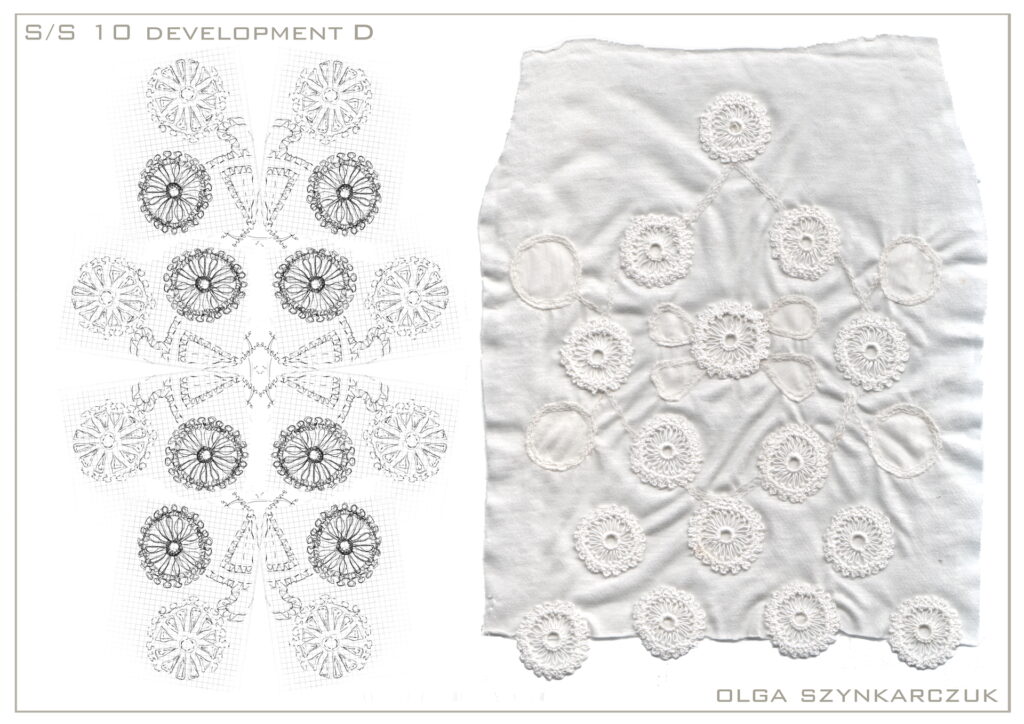
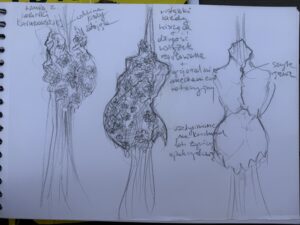
I keep revisiting my idea of using wicker weaving as a base of pregnant torso shaped lamps as well as testing the lace with sugar water and starch to make the shapes. I am simultaneously knitting a red “frame” for my Maiden/Mother/Crone Triptych but wondering if maybe it would be a better idea to use sugar water/starch shaped lace for the frame as it feels more relevant, closer to the oldschool female crafts techniques used for ages and somehow more fragile, more feminine, more delicate and easier to mould. I am also looking at my old design ideas from over 20 years ago and how lace was such a huge part of my story as a designer when I had my own brand, especially the lace from the polish area of Koniakow, where I still am in touch with the female creatives who make the lace elements. Looking through old design ideas:
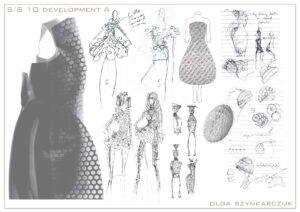
I am now thinking of combining a super old lampshade my grandmother once made from vintage post war lace with my great grandmother’s hat shaped on wooden heads and my grandmother’s dresses she knitted, crocheted and embroidered for my collections
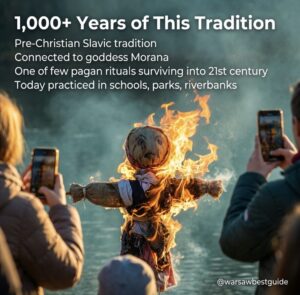
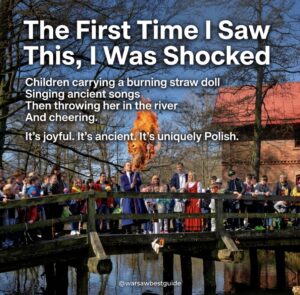
SLAVIC TRADITIONS: TOPIENIE MARZANNY – After Marzanna burns and drowns, Spring begins
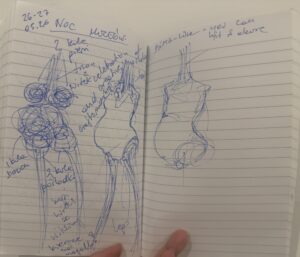
The death of winter and arrival of Spring: straw and ribbon female figures made only to be carried through the village, set on fire and drowned in the river. Symbolising the end of old and cold, the beginning of new: fertility, celebration of things springing back to life, growing after a period of long, cold, lonely winter. Idea: wicker sculpture pregnant/postpartum female form covered in lace shaped in starch. The wicker technique is the chaotic entanglement of the female brain when it is preparing to become a mother: MATRESCENCE, entangled completely, as if with madness, as part of her entire being, a metaphor for her old selfdying and newself coming to life while becoming a mother




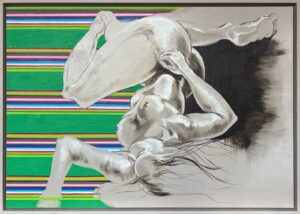
Also thinking about embroidery and how it might be interesting to add embroidery to painting I did a while ago. It is a folk stripe and nude painting and I am really tempted to add black and/or white thread embroidery to it, maybe in a form of embroidering the actual figue or maybe adding unfinished elements of lace-like pattern in black next to the figure.
The reason I am thinking about this and asking: Why Folk? Why polish craftsmanship? What is so important about it that I keep wanting to include it in my work? The rainbow colours in my lamps, that again is the repetition of the same colours from the polish traditional tapestries and folk dancer costumes still worn by folk dancers till this day.
Remembering the first drawing I did with added folk stripes, now hanging in my parents kitchen, because this was their absolute favourite one. I wonder why. But I think there is something here that connects my thinking when working on it with the way of thinking of the small polish village folk from the ancient slavic times of legends, witches, and ghosts. Thinking of Adam Mickiewicz’s drama called and based on Dziady, an ancient Slavic and Lithuanian feast commemorating the dead (the “forefathers”). The drama has four parts, the first of which was never finished. Parts I, II and IV were influenced by Gothic fiction and Byron‘s poetry. Part III joins historiosophical and individual visions of pain and annexation, especially under the 18th-century partitions of Poland. Part III was written ten years after the others and differs greatly from them. The first to have been composed is “Dziady, Part II”, dedicated chiefly to the Dziady Slavic feast of commemoration of the dead which laid the foundations of the poem and is celebrated in what is now Belarus
It is very interesting that my great grandmother came to Poland from what is now called Belarus. Knowing Dziady is known for its varying interpretations, the best known ones being the moral aspect of part II, the individualist and romanticmessage of part IV, and the deeply patriotic, messianistic and Christian vision in part III. I am more interested in the interpretation by Zdzisław Kępiński, (strangely Kępiński being my mother’s father’s name), who focuses his interpretation on Slavic pagan and occult elements found in the drama.
I am fascinated by the idea that death and grief and joy and dance can almost coexist next to one another and I feel that the slavic pagan people were much more able to live truly, understanding how intertwined life and death are, not escaping old age, getting wrinkled and sick, not pretending death doesn’t exist, not avoiding talking about it. Death and old age were part of life and birth, they coexisted, they lived in the same single room simple houses, when someone was old and sick they lived with the family, they were not put in old people’s homes. When they died they were at the house for a week so the whole family could have time to say goodbye. I feel there is something true and honest and real about that and only by becoming a mother and watching my parents age and realising how fleeting life is I am becoming increasingly interested in this subject.
I also am fascinated by the connection between Mickiewicz’s Dziady and ZOfia Stryjenska, one of my favourite polish painters:
Zofia Stryjeńska (1891–1976) was an outstanding Polish painter, graphic artist, and illustrator in the Art Deco style, often called the “princess of Polish art.” Although she did not create a direct illustration for the drama Dziady by Adam Mickiewicz, her work is rich in Slavic demonology, folklore, and dance, which thematically brings it close to the atmosphere of folk rituals.
Zofia Stryjeńska and folk motifs / “Dziady”:
- Slavic themes: She created thematic series based on Slavic mythology, pagan rituals, and dances, which correspond to the folk character of Dziady.
- “6 reasons why Stryjeńska sold her soul to the devil”: Publications about the artist often refer to her turbulent life and fascination with supernatural forces, using metaphors similar to those found in Mickiewicz’s work.
- Style: Her works are characterized by vivid colors, dynamic forms, and stylized folk elements.
Stryjeńska is an icon of Polish culture of the interwar period, boldly combining tradition with modernity, which makes her artistically kindred in spirit to Dziady.