
I love David’s idea of “Whatever you see a lot of’ the artist notes, ‘you can use, you can build something off of!” combined with the absolutely magical feel of his cooking fat and pigment pieces, which do not look like they were made from waste at all. There is something about the use of the artists own body and pressing it against flat surfaces that must feel very liberating. And the idea of using discarded materials and making them into something beautiful feels very familiar to me.
MATERIALS AND OBJECTS 3
DAVID HAMMONS
In this room, discarded materials are transformed into artworks, playing with cultural assumptions of value.
Across his six-decade career, David Hammons has consistently challenged the conventions of artmaking. His sculptures, installations, prints and performances use found materials others might consider waste – from cooking fat, to hair swept from barber shop floors.
They question notions of fine art and test the limits of museum conservation. Hammons regularly works outside traditional studio and gallery environments, positioning himself as an art world outsider. I like doing stuff better on the street’ he notes, ‘because the art becomes just one of the objects that’s in the path of your everyday existence. It’s what you move through, and it doesn’t have any seniority over anything else.
Born in 1943, in Springfield, Illinois in the United States, Hammons studied art in Los Angeles before moving to New York in 1974. He is associated with the Black Arts Movement (1965-1970s), a group of writers, musicians and artists who sought to address the needs and aspirations of Black America. The movement was characterised by the creation of new African American led organisations and works of art that reflect Black pride, heritage, and contemporary experience.
Hammons’ practice incorporates materials, objects, imagery and language associated with everyday African American life. Whatever you see a lot of’ the artist notes, ‘you can use, you can build something off of! The resulting artworks explore his personal experiences while challenging broader cultural stereotypes.
Hammons notes: 1 think I spend eighty-five percent of my time on the streets as opposed to in the studio. So, when I go to the studio I expect to regurgitate these experiences of the street. All the things I see socially – the social conditions of racism – come out like a sweat!
Curated by Katy Wan, Managing Curator,
D. Daskalopoulos Collection Gift
The Anita Zabludowicz Gallery
Find out more about the D.Daskalopoulos Collection Gift
David Hammons 1943
Born and works US

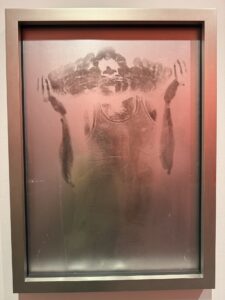
Untitled 1975
Pigment on paper
Hammons created these works by covering his naked body in cooking fat and pressing himself against paper or card. He applied powdered pigment to the greasy surface to set the image.
Hammons’ Body Prints date back to 1968 and are some of the artist’s earliest works. They reference Yves Klein’s 1960 ‘anthropometry’ paintings. In these performance-happenings,
Klein directed the movements of naked women, producing imprints of their painted bodies on paper. The pigment of Blue Angels acknowledges Klein’s characteristic use of the self-registered colour ‘International Klein Blue’. In Hammons’ series, the artist chooses to take on the role of author, subject and printing plate himself.
Presented as part of the D.Daskalopoulos Collection Gift 2023
T16129, T16048