
As I am simultaneously priming fridge door, writing quotes for Triptich series, testing the stained glass outliner, I am watching the Yes, We Exist. Artist-Mothers Share Their Stories., 2018) documentary. I stumble upon the work of Tanya Aguiniga and I am absolutely spellbound. She is using yarn and hair and the pieces are just unbelievably beautiful but also honest and tactile. She uses working class materials to create a political dialogue about the types of work that women make. She also talks about her identity, and the fact she crossed the border every day for 14 years, between 4 and 18 years old, between the US and Mexico. She calls it “identity crisis”, trying to figure out where she fits in. She was making furniture before because she felt she wanted to make things her family considered “useful” unlike conceptual sculptures, which she didn’t think she could allow herself to make. It seems that it was thanks to motherhood that she allowed herself to “break free from functional work” and was able to start calling herself an artist. She mentions ” my life was being transformed by working with women weavers in Chiapas and seeing them being able to combine being makers and heads of household. all in the same space. “My whole practice changed after that experience. Understanding how we can relate to each other as women and how we can make safer space.”
She also talks a lot about all the crazy things that happen to your body, she talks a bout post natal depression, when she created “Mothering the form”, she describes it as “objects that are longing for something, objects that are depleted, objects that are codependent.” It was work about “being in the middle of post-partum depression” and “nest forms exploring body as a vessel”
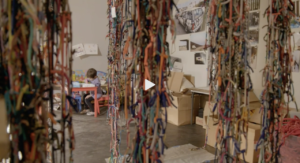
And then she moved onto THE HAIR: “To me the most universally specific, gender-specific, universal thing that all of us humans have is hair. I’ve just been reall interested in exploring all those ideas of gender and identity. For “Reindigenising myself” I used my hair, my sisters hair and my daughters hair and then some of the other pieces that are in this exhibition are these massive Palapas, that are covered in synthetic hair. Those pieces have to do with, like, as a person of colour, being constantly compared to, like this classical ideal, like a barbie, like, white woman. So it’s platinum blonce hair weave.”

