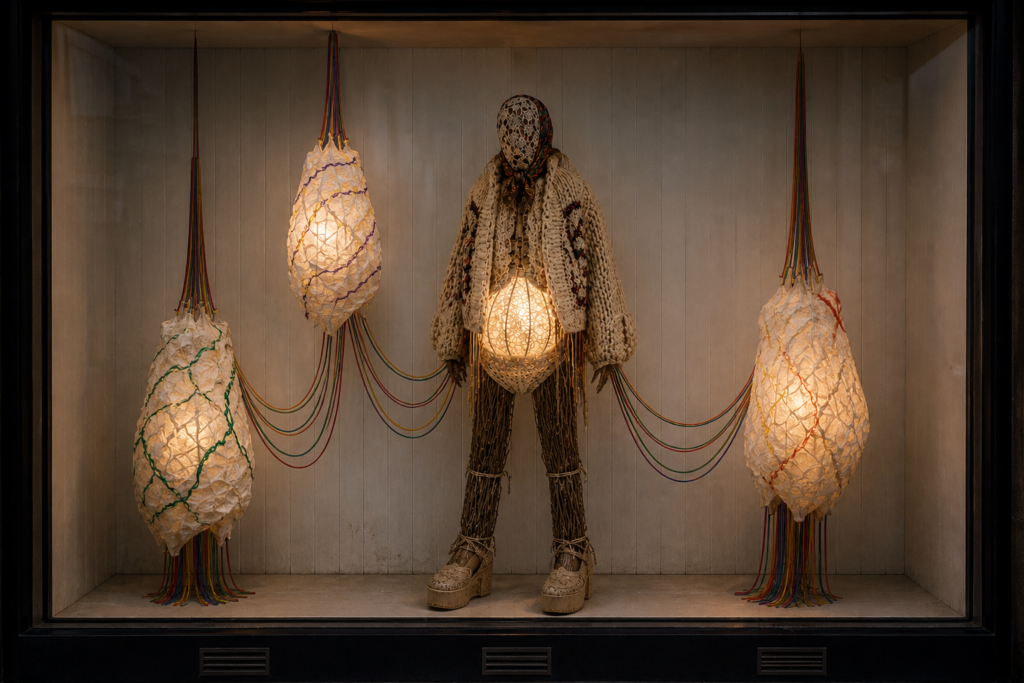
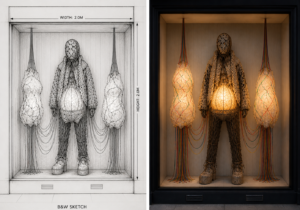
Noc Muzeow is a once a year, overnight event in Warsaw, when all the Museums and some galleries are open all night and accessible for free for everyone who might be interested in experiencing an evening with Art. This year I feel honoured to have been invited to participate in a group show at Jaga Hupalo’s Hair Studio/Gallery, which is located in an Old Lace Factory building, as part of an exhibition Rock. Paper. Scissors. I couln’t have imagined a better place for my lace, paper, wicker Marzanna/Straw Puppet installation. It will need to be created in one day, 15th of May, installed on the 16th and taken down on the 17th so it is almost more like a performance than an exhibition, completely mad but also very exciting
- Symbolism: She embodies winter’s icy grasp, pestilence, and death, but her drowning represents the triumph over these, allowing the Goddess of Spring (such as Vesna or Lada) to return.
- Ritual Procession: Children and adults parade the effigy, which is often dressed in white, through the village before throwing it into a river, lake, or pond.
- Origins: The tradition dates back to medieval Slavic paganism, particularly in Poland, Slovakia, and the Czech Republic.
- Modern Adaptation: In modern times, the ritual is often seen as an eco-friendly celebration of the end of winter. Concerns over pollution have led some to prefer making smaller, fully biodegradable dolls or using natural materials like straw and flax.
The work emerged from a need to confront the tension between the personal experience of motherhood and the cultural burden of the figure of the “Polish Mother” (“Matka Polka”). Deeply rooted in Polish tradition, this term carries the expectation of total sacrifice — a love so absolute that the woman as an individual ceases to exist, dissolving entirely into the role of the mother.
“Matka Polka Marzanna” references the ritual of drowning Marzanna — the symbolic farewell to winter. In this work, that gesture is reversed and problematised. It is not only the departure of what is “cold” and “dead,” but also an attempt to erase a woman’s former identity: her autonomy, memory, and desires. The old self is burned and submerged — not necessarily by choice.
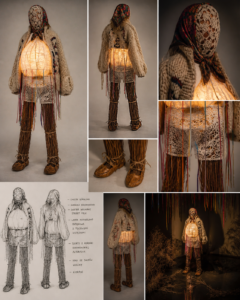
An important element of the work is the use of craft materials: wicker, a hand-knitted sweater, Koniaków lace, and traditional highlander shoes (kierpce). These materials carry a multigenerational, often familial tradition of handmade labour — a quiet, repetitive effort connecting care, domesticity, and creativity. Their presence expresses respect for the skills of women who, for generations, combined motherhood with craft work.
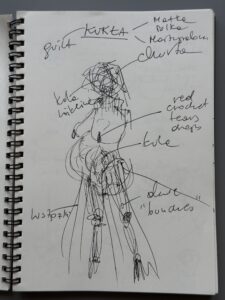
The abstract pregnant belly — created from a recycled drawing of a dancer-mother on tracing paper — speaks of the pressure, exhaustion, fragility, and physical stretching that motherhood inscribes onto the body and identity of the artist-mother. The lamp form glows softly from within, revealing how close to the surface the inner world exists: almost visible, almost breaking through. Illuminated by a pulsating light that imitates the beating of a mother’s heart, it reminds us that beneath this delicate surface, intense emotional and physical labour is constantly taking place.
The motif of the mask — made from lace — together with the Koniaków lace underwear, refers both to concealment and to intimacy and inheritance. I have worked with Koniaków lace for years and remain fascinated by its enduring delicacy, strength, and symbolism. Lace-making is deeply personal to me because, much like in my own family, it is a craft passed down from women to women. The lace conceals, yet never fully disappears: it allows us to sense that beneath the surface there is still someone more than the assigned role.
Light filtering through these materials acts as a medium of revival — revealing their structure, fragility, and traces of use. It binds the elements of the installation together, giving them new life and meaning. In this way, the project becomes a story about repair, recovery, and transformation — about what has been rejected, worn out, or hidden, and what can be seen and reworked anew.
The work does not reject motherhood, but reveals its complexity — as an experience filled simultaneously with love and loss, intimacy and symbolic violence. It asks: what exactly must be “drowned” for a woman to be recognised as a “good mother”?
“Matka Polka Marzanna” does not propose a single resolution. Instead, it holds the viewer in a moment of transition — between immersion and emergence, between what disappears and what stubbornly remains.
|
Oskar Kolberg
|
|
|---|---|
.png)
Henryk Oskar Kolberg
|
|
| Born | 22 February 1814 |
| Died | 3 June 1890 (aged 76)
Kraków, Poland under Partitions
|
| Occupation | Historian, ethnographer |
| Language | Polish |
| Nationality | Polish |
| Genre | Ethnography, history, personal correspondence |
| Literary movement | Modernism |
| Notable works | Pieśni ludu polskiego (1900-03)
|
Henryk Oskar Kolberg (22 February 1814 – 3 June 1890) was a Polish ethnographer, folklorist, and composer active in Partitioned Poland.[1]
Life
Kolberg was born in Przysucha, the son of the German Julius(z) Kolberg, a professor of the Warsaw University, and Fryderyka née Mercoeur, Warsaw-born while being of French descendance. His family’s acquaintances included Samuel Linde, Nicolas (Mikołaj) Chopin (father of Frédéric Chopin), and Kazimierz Brodziński.
He is best known for his work titled Lud (re-published as Dzieła Wszystkie), a compilation of folk traditions from all the Polish regions. Between 1857–1890 he published 33 volumes, and after his death, a further 3 volumes were published. The compilation contains 12,000 folk songs, 1,250 folk tales, 670 fairy tales, 2,700 proverbs, 350 riddles, 15 folk spectacles and many other ethnographic documents. Ethnobotanist Maria Hempel supported Kolberg with his study of the Chełm region.[2]
Kolberg also compiled some ethnographic information on neighboring regions. He died in Kraków.
It was thanks to the thorough research of Kolberg that Warsaw Village Band (Polish: Kapela ze wsi Warszawa) is a band from Warsaw, Poland, that plays traditional Polish folk music tunes combined with modern elements was able to find resources and inspiration for their songs
About the band
According to the band’s manifesto, it was formed as a response to mass culture and narrow-mindedness, “which in fact leads to [the] destruction of human dignity.”[1] After the fall of the Berlin Wall and the expansion of the European Union to most of the former Warsaw Pact countries, Poland’s economy has grown dramatically, as has investment by multinational corporations, raising concerns about the loss of Poland’s cultural identity under globalism.
Warsaw Village Band was conceived as a response to this trend that would explore Poland’s musical traditions and make them relevant to its new capitalist economy. Member Wojciech Krzak has stated that “after the nightmare of Communism, we still have to fight for our identity, and we know that beauty and identity are still in our roots.”[2] Krzak has further stated that the band are “trying to create a new cultural proposition for the youth in an alternative way to contemporary show-biz.”[3] The band’s very name appears to evoke what troubles Krzak about Poland’s new capitalism: many large Polish cities do not have suburbs in the traditional sense, leading to unsettling transitions directly from city to field.[4] To this end, in Wykorzenienie (Uprooting), the band traveled throughout Poland to find and record older musicians who still played almost-forgotten styles of music, thereafter incorporating those melodies into new songs and expounding upon them.
The band also incorporate socially conscious folk lyrics in their songs. The song “Kto się żeni” (“Who is Getting Married”) on their second album, Wiosna Ludu (People’s Spring), discusses a young country girl who refuses to be married off, opting instead to “sing, dance, and be free rather than being dependent on someone.”[5]
Warsaw Village Band have appeared at several international music festivals, including the 2005 Roskilde Festival in Denmark, the 2004 Masala Festival in Hanover, Germany, and the 2000 International Ethnic Music Fest in Germany.
Instrumentation


Notably, Warsaw Village Band have revived several musical traditions that were all but lost in Poland. The band use instruments rarely heard in modern music: frame drums, the hurdy-gurdy and the suka, a Polish folk fiddle from the 17th century stopped with the fingernails rather than the fingers, similar to the Bulgarian gadulka, the sarangi, or the rebec. The suka was practically unknown to the Polish people until member Sylwia Świątkowska began to play it in the band’s concerts, and, later, on their albums. Additionally, many of the band’s vocals are sung in a loud and powerful style remarkably like the “open-throated” singing styles in Bulgarian music, called biały głos (white voice). This style of singing was used by shepherds in the Polish mountains to be heard for long distances.[6]
Warsaw Village Band have also used modern elements in their music. Wykorzenieniecontains scratching by the Polish hip hop artist DJ Feel-X,[7] most likely as a nod to the phenomenal popularity of hip hop in Poland. The same album also includes electronic sirensound effects by the band’s sound engineer, Mario “Activator” Dziurex, leading to a peculiar juxtaposition of new sounds upon old melodies.
Albums
- Hop Sa Sa (released in US and UK as Kapela ze wsi Warszawa) – 1998
- Wiosna Ludu (People’s Spring) – 2002
- Wykorzenienie (Uprooting) – 2004
- Wymiksowanie (Upmixing) – 2008
- Infinity – 2008
- Nord – 2012
- Święto Słońca – 2015
- Re:akcja mazowiecka – 2017
- Uwodzenie – 2020
- Sploty – 2024
Awards
Warsaw Village Band were nominated for the “Newcomer” award in the BBC Radio 3 World Music Awards in 2003, and won it in 2004.[8][9] The band also won the Polish musical competition “New Traditions” in 1998.[10]
- 2005 – “Fryderyk” – the best Polish Folk album of the year (“Uprooting”).
- 2009 – “Fryderyk” – four nominees (“Upmixing” won the award in the best Polish folk / world music album).
- 2010 – “Fryderyk” – two nominees (“Infinity” won the award in the best Polish folk / world music album).
- 2016 – “Fryderyk” – the best Polish roots music (“Święto Słońca”).
- 2018 – “Fryderyk” – the best Polish roots music (“Re:akcja mazowiecka”).
https://en.wikipedia.org/wiki/Warsaw_Village_Band