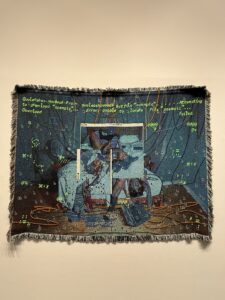
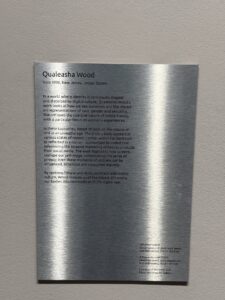
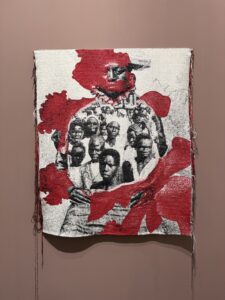
Someone I met during the “Repeat After Me” exhibition opening invited me to see this exhibitioin with her. I have been quite mesmerised, especially by the work of Qualeasha Wood, which I have already previously seen at Somerset House as part of the Virtual Beauty and the V&A Design and Disability exhibitions. Wood’s idea of combining online image overload with traditional techniques is something I feel I have never seen before.
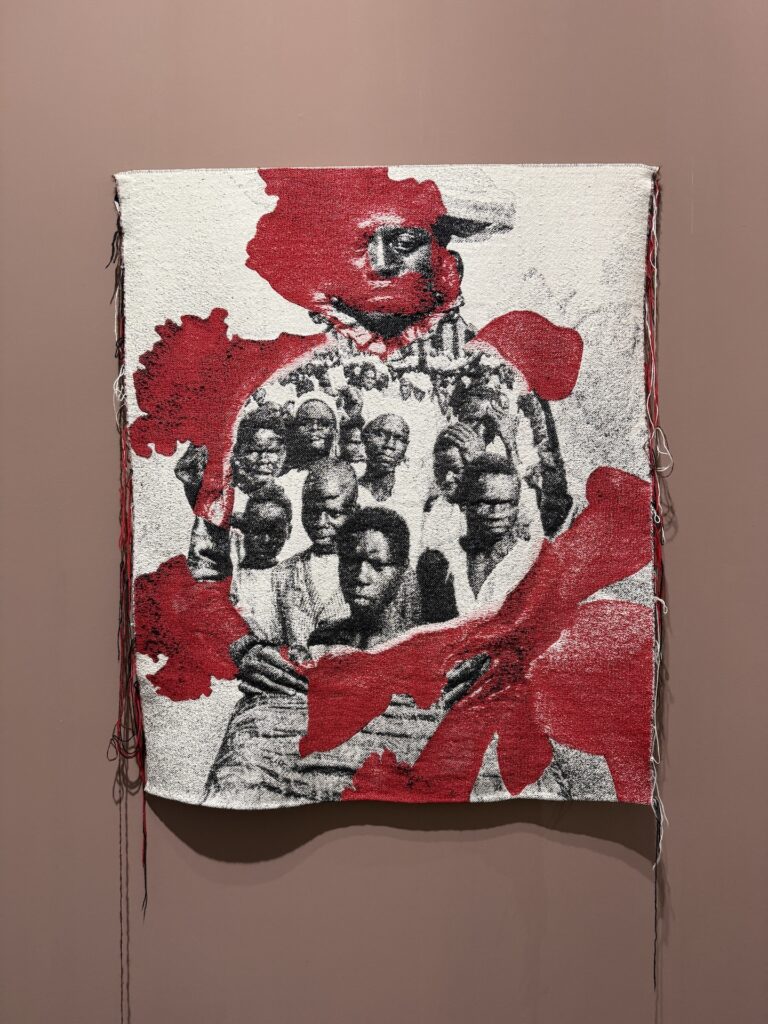
Similarly, experiencing the work by Jess Atieno, who, by combining tapestry, photography and silkscreen she constructs enquiries into post-colonial Africa, and who works primarily with images, postcards and maps produced during Britain’s colonisation of present-day Kenya, Uganda and Tanzania. I absolutely love the combination of contemporary silk screening with the handmade unravelled threads of the tapestry. The artist does not seek to use the archive to heal these histories, but to examine how they continue to haunt the present. Her puzzle-like compositions agitate and disrupt, using cut-ups, multiple exposures, tapestry and silkscreen. It makes me want to delve further into the work of my grandomother, and her motivation behind the work, as well as other textile artists, who were Magdalena Abakanowicz’s contemporaries.

EXHIBITION DESCRIPTION
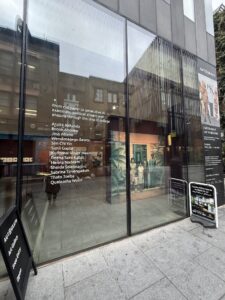
This major group exhibition examines how photographs can be deconstructed and reassembled through the idea of collage, offering new perspectives on complex histories and contested social realities.
With deep roots in activism and artistic experimentation, photomontage has a rich legacy as a powerful tool for artists engaging with experiences of political dissent and erasure. Its possibilities are amplified by the relentless evolution of photography – a medium shaped by technological advancement and the shifting politics of representation.
From cut paper to generative AI, more than 90 works by 13 contemporary artists use collage as both method and metaphor, highlighting the fragility of photographic ‘truth’ and the archives that hold it. Sabrina Tirvengadumuses an AI model she trained on family photographs to reconstruct a fractured history shaped by the legacy of indentured labour in Mauritius; Sunil Gupta’s digital collages from the 1990s navigate the intersections of queer identity and diasporic experience; and Qualeasha Wood transforms self-portraits into tapestries that reflect on bodily autonomy and the pressures of internet culture. Jess Atieno troubles colonial archives in East Africa to explore how histories can be restitched into counter-narratives, while Sheida Soleimani creates layered tableaux that link political exile from Iran with the care of injured migratory birds.
As we reflect on the future of image-making, I Still Dream of Lost Vocabularies resists completeness, questioning whether constructed images can stand in for disputed – and often entangled – narratives when words fail.