
Paintings and conversation about women painters. I stopped by one of the top Warsaw auction houses to see an exhibition I was really interested in as an inspiration for my research paper. But I was also astounded to see such initiative among young curators, to push female painters tackling domestic struggles, on such a large scale. As one of the curators mentioned, there is a long road ahead as the clientele in Poland, people who want to invest in in young art, are still quite new to the art market themselves and need to be gradually educated by the curators. Only recently, the prices of the interwar Polish art made by women started rising and clients are suddenly really interested in buying it.
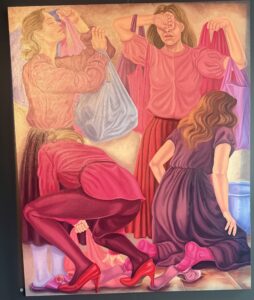
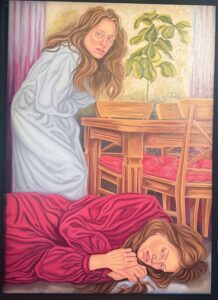
Dorota Kuźnik’s work tackles the uncomfortable in a form of gracefully posed, attractive female poses and eye pleasing fashionable colour combinations. She makes the uncomfortable desirable in her own stylish protest: “In my world I expose stereotypical views of femininity and the confinement of women within the domestic sphere. I communicate the constructed nature of women’s prescribed roles through the choreography of figures and gestures.”




But it’s all up to the curators as well as the artists to continue addressing maginalised voices, to tackle the maternal in art, to prove that it is, indeed, possible, to be an artist and a mother and that having chidren does not have to put a stop in one’s career. But it requires acknowledging, making artists status as parents visible, ideally to respect each of the points described in the below manifesto:
HOW NOT TO EXCLUDE
Artist
Parents
Some Guidelines for Institutions and Residencies
“Supporting diversity whether it be age, ethnicity, gender, lone or parental status isn’t just about being fair – it’s also about us allowing a diverse flow of experience, nuance, innovation, invention to flourish so the work, the gallery, the practice of art is as rich as it can be. Dispensation for real life needs to start to be built into all collaborations with artists.” (Melanie Jackson)
An introductory statement:
While responsibility for childcare currently falls overwhelmingly on mothers, we are using the word ‘parent’ in these guidelines in the hope that this may change.
An introductory suggestion:
Treat the artist as a whole person.
An introductory request:
Be flexible.
1. As an organisation, be explicitly welcoming to artists with families
Be breastfeeding friendly; stay in contact with artists when they become parents.
The art does not need to be family friendly, but the institution should be.
2. Make it standard practice to establish an artist’s family circumstances at the outset of a project, and have structures in place to accommodate their parenting responsibilities
It shouldn’t be left to the artist to have to ‘confess’ to being a parent, or to fear they may lose a show, commission or residency if they do so.
3. Assume that any artist parent may need to travel with their children and a partner or other caregiver, and provide for this.
4. Agree with the artist at the outset what is expected of them and when, and give enough lead time so that they can plan accordingly
Don’t make urgent last-minute requests for texts, talks, and other extras.
5. Consider having a specific budget for an artist’s childcare costs
Discuss childcare costs upfront with the artist and be clear about what you can and can’t cover.
Allow artists to invoice for that portion of their fee that they will need to spend on childcare as a direct cost so that they won’t be taxed for it as income.
6. Schedule openings and special events as convenient to artist parents
Consider options such as weekend daytime private views rather than sticking rigidly to early evenings when children need to be fed, bathed and put to bed.
7. Be aware of term dates and program around them
Offer artists who need to travel with children the option of installing a show over half term, for example.
8. Re-think or remove age limits for residencies and awards so that they become inclusive of artists whose careers have been interrupted by having and caring for children
9. Work with artists to adapt residencies to fit around their parenting needs
This may involve allowing the artist to split the residency period into more manageable sections, or supporting them through a research and development period in their own studio if they can’t travel.
10. Don’t read gaps on a CV to indicate a lack of commitment or effort
Artists’ careers come in many shapes, and are paused for many reasons, parenting among them.
Emerging artists are not always those who graduated most recently.