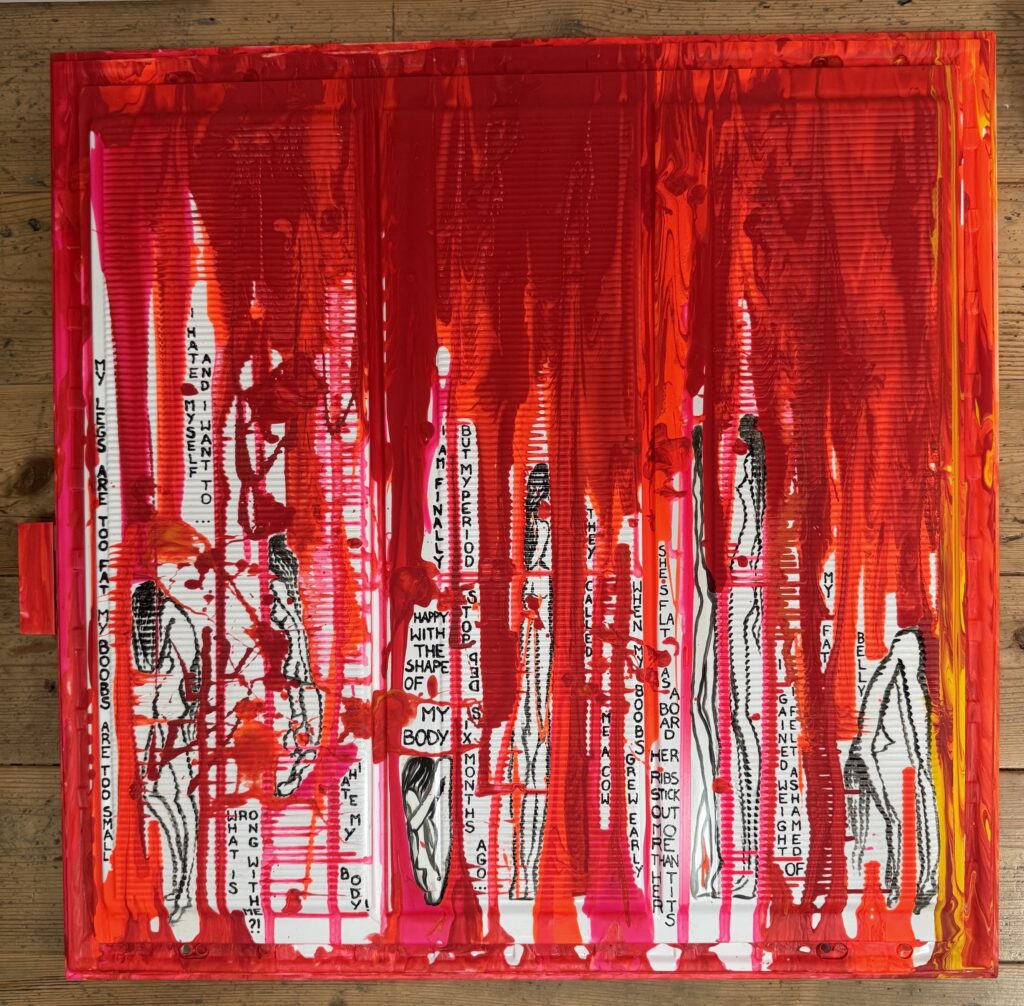
I’ve been worried about The Maiden painting, as a little bit of the acrylic paint started chipping off the plastic. I was also quite unhappy with the oil paint figures, the brush strokes really getting on my nerves. I decided I will need an industrial varnishing from a car shop to save the paint that’s chipping off. I also decided I wanted to rub off the oil paint and try to include thread in the process and thought I might try and embroider on the dissolvable paper, then try to stick the embroidery onto the fridge door. In the embroidery process, which I really enjoyed, I must have miscalculated the stitching technique and once I put the piece into the water, well…the whole thing that took me about 4-5h to embroider, completely fell apart, it immediately shriveled like a FFWD prune and turned into a tangled blob. Not sure what I’m going to do about this just yet.
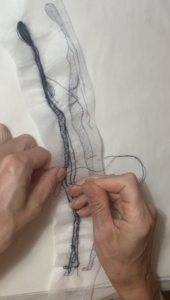

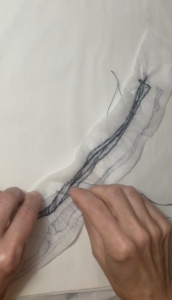

Next steps: I still want to have thread in this, especially as hair on the heads of the figures, so I might experiment with combining the outliner I used for writing, make the outline and then dip the bits of thread into it. Let’s see…trying not to give up is the hardest thing when you’re stuck in your studio, something fails, and you just want to set it all on fire. The doubts about absolutely everything creep in, all the failures are reminded alongside this one and there seems to be no clear path or solution. It’s basically just trial and error, just keep swimming…
Listening to: the paper Rebecca Fortnum’s On Not Knowing and feel like I couldn’t Not Know any more than now, couldn’t feel more lost
70
“Artists want to encounter, in their final work,something that does not feel known to them.If an observer finds an artist’s outcome entirely predictable, very often it has not been so for the artist making the work. “
“Having a technique to facilitate unforeseen events is a classic technique of modernist art.” Michael Ginsborg
73
Daniel Buren describes the traditional artist’s studio as an “ivory tower” and Buren’s critique finds a natural heir in the relational work of the contemporary museum scene. The studio has become theoretically indefensible; acting as a barrier between artist and audience it exemplifies convention and tradition, insulating the artist from the world and feeding their natural solipsism. John Baldessari appears to reinforce this with his comment, “A studio is a sanctuary where the artist should be everyday as long as possible… to do art one must choose self-imposed exile.
76
It appears that, on occasion, when difficulties and doubts about suitable subject matter or procedures arise it feels as if the medium comes to the artist’s rescue. Rachel Lowe says,“Sometimes I don’t know what to do, often I will do something physically, like film something or use collage which will then lead onto an understanding of what I’m trying to say through the work.”17
76
Jarvis’ use of the word “intuitive” deserves some attention here as the term enjoys a problematic status within the vocabulary of contemporary visual art.The influence of the new art history has seen it outlawed in contemporary debate, equating it with uncritical, overtly personal practices. However in my conversations with artists I have been interested to see the word re-emerge, albeit in a qualified form. Artist Runa Islam says:
I don’t ever use that word [intuition], maybe because it seems like a rude word in art, at least in art school. Can you imagine art tutors saying
77
to students, ‘use your intuition’, and then going off on a coffee break? [However] sometimes you need to follow your instincts or inner rationale alongside the critical thinking. Especially when you’re trying to distil or capture something that hasn’t yet been named or articulated. I have to admit that no matter how much I try to control my working process, there’s always that moment when pure improvisation/ inspiration takes hold. Maybe that’s intuition.20
Fortnum: This approach also prevails in our methods of accounting for art practices (funding bids, project proposals, etc.) where it appears faith has been lost in the legitimacy of art practice as a mode of enquiry in itself.