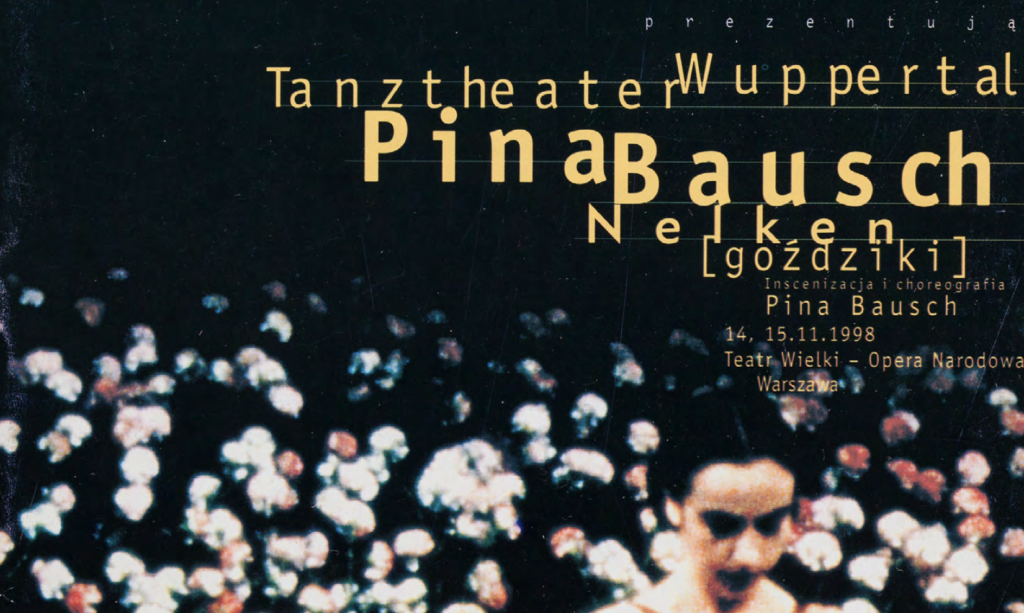
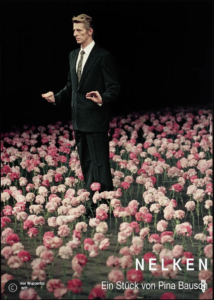
I have been obsessed with Pina Bausch dance company since I first saw The Rite of Spring almost 30 years ago, in 1998 in Warsaw’s Sala Kongresowa (https://www.pinabausch.org/archives/programme/nelk_19981114_61_0000), not just the touching and emotionally charged dancing but the astounding and magical set design: when I saw that floor in Nelken, covered in soil and then in hundreds of pink carnations, accompanied by the musicsomehow that image has been embedded in my head forever. Also, reading the pamphlet from the 1998 about Pina’s work, I am astounded by the fact that already in the 1970s “before Arno Wüstenhöfer appointed her director of ballet at the Wuppertal stages under his leadership, she had already articulated in the work Nachnull her departure from classical modern dance movement. The “broken,” worn-out, fatigued gestures signalled an approaching doubt as to whether the world — even if it is the world of dance — can be explained through a normalised language, abstracted from storytelling and fairy tales.
Later, in the subsequent works created in Wuppertal, the themes, forms, and working methods gradually emerged that are characteristic of Pina Bausch’s contemporary style and aesthetic. Even at the time when she transformed Gluck’s operas Iphigenia in Tauris and Orpheus and Eurydice into ballet performances according to a pure modern dance theory, one could already see in them that compassion for women-victims which later reached its culmination in the great lament of The Rite of Spring.
This developed into an attempt to “repair” the world of men in 1976, in an evening devoted to the works of Brecht and Weill, where for the first time the perfected form of the new Wuppertal style was introduced — Women’s Liberation on the ballet stage — this time radiant, conscious of victory, and devoid of any shyness.”
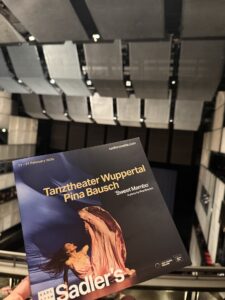
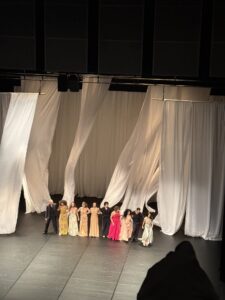
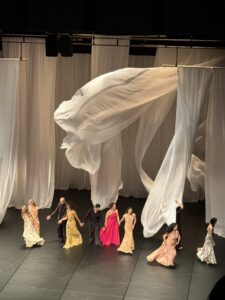
It was the same case in Pina Bausch group’s 14.02.26 Saddlers Wells Angel performance of “Sweet Mambo”, with male-female violence subtly but unshyly expressed by the dancers, the complicated balance. The expression of the difficulties of life expressed so beautifully by “Bausch’s dancers-turned-collaborators” who “bring years of experience, influenced by their own personal recollections, to communicate in movement what can’t be said in words.” I felt unsettled and moved, trying desperately to get back/wake up in my head the feeling of almost 30 years ago, at 16, when I felt just purely happy and so inspired by Bausch’s Nelken. 28 years later realising I’m now 44 years old, in a relationship lasting longer than 20 years, after some previous failed relationships full of love, abandonment and dissapointments. It is not currently possible for me to just feel “innocently happy” but in turn what resonates with me is the fact that “this performance explores our inner motivations and lays bare the sweetness and severity of life.” and maybe it is less joyful and innocent but there is the brutal honesty in it that makes me feel like I currantly have a life deeply lived, with all it’s joys and sorrows combined. And maybe feeling so much all the time is worth more than just being blissfully happy all the time.

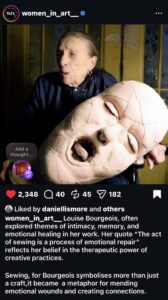
And that led me to thinking of repair, and the idea that no matter how traumatic and difficult, there is always possibility of repair and it is Louise Bourgeois quote, which led me to that idea in @women_in_art: “Louise Bourgeois, often explored themes of intimacy, memory, and emotional healing in her work. Her quote “The act of sewing is a process of emotional repair” reflects her belief in the therapeutic power of creative practices. Sewing, for Bourgeois symbolises more than just a craft, it became a metaphor for mending emotional wounds and creating connections.”
And yet again my brain starts to wonder whether it might be at all possible that sewing/mending might be the answer to my emotional struggle with mother-artist identity.