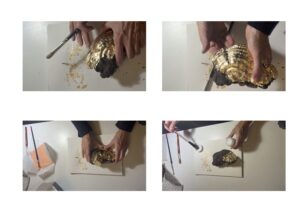
Coming to Warsaw for a weekend to shoot a music video using my wings, clothes from my past collections and earrings as props. It comes with baggage. Conversations about great grandma and grandma and everyone else, who is no longer with us, predominantly due to cancer. Talking about our own fears: should we get a genetic test, what’s the probability i my grandmas sister daughter died from cervical cancer. Basically, as soon as you think death, you think cancer. If someone died in the age 40-90, there is a high probability it was from cancer. According to google Europe records roughly 4.5 to 5 million total deaths per year, with cancer accounting for about 20% to 23% of all deaths. In my closest family alone we lost 3 women all to cancer, various types: great-grandma – liver, grandma – brain, mums cousin – cervical. It suddenly dawned on me and I started thinking: how do I approach this? Do I panic? Do I start spending all the money to get all the possible tests to try and prevent it from happening? How to I take control? Or how can I get used to the thought that it might some day happen: to my mum, to me…most people would probably say it’s a waste of time, it is probably completely pointless to think about it now. What if I wanted to connect with people who, like me, have family history and are worried? And if so how are we connected, what do we have in common? Why am I so drawn to them? Is it because deep down I connect through them, the way I feel I connect through trees, or when using my hands for sewing, embroidery or crocheting? Am I trying to find a way to prevent/to heal my mum/myself before anything happens?
Great grandmother had a summer house in the forest.
She collected tree mushrooms and made things out of them.
Did she believe these mushrooms had healing properties?
Looking at them up close they remind me a bit of tumors: brown, twisted, smelling of decay, growing easily. That’s my first impression
But in the past they were seen as talismans/healers, by these “crazy” healer Baba Jaga’s from pre-witch times, when people treated them with respect, when it was believed they had a deeper connection with nature than common humans?
BRAIN LUNGS HEART
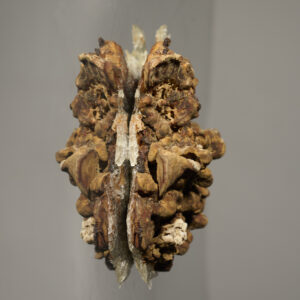
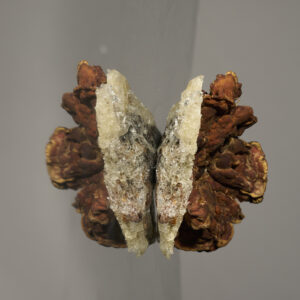
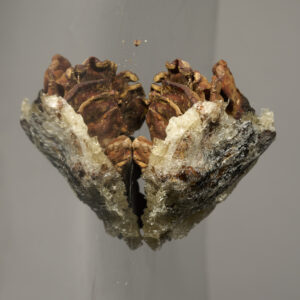
A common bracket fungus that grows exclusively on dead or weakened birch trees. It produces large, semicircular fruiting bodies with a whitish to pale beige colour and a soft, cork-like texture that hardens with age.
Although it is not edible due to its tough texture, the birch polypore has a long history of medicinal and practical use. In traditional medicine, it was used as an anti-inflammatory, antiviral, and digestive-supporting remedy. Infusions made from the fungus were believed to have antiparasitic properties and to strengthen the body.
The fungus contains, among other compounds, betulinic acid, which has been shown to possess antibacterial and anticancer properties.
Historically, the birch polypore was also used as a natural wound dressing. Pieces of the fungus were applied directly to wounds to protect them and promote healing.
Did you know?
Birch polypore was found among the possessions of Ötzi the Iceman, who lived more than 5,000 years ago. It is believed that he carried it either as a medicinal remedy or as an amulet.
Common Tinder Fungus (Fomes fomentarius)
One of the best-known wood-decaying fungi, it grows mainly on dead or weakened deciduous trees, especially birch and beech.
In European mushroom field guides, it is commonly described as an inedible fungus.
Its fruiting bodies are hard and hoof-shaped, with a grey or brown outer surface. The flesh inside has a cork-like texture.
The tinder fungus causes white rot, a form of wood decay that is considered economically damaging to timber.
For centuries, it was used as a natural tinder. When dried and properly prepared, it easily catches a spark and smoulders for a long time. The Latin word Fomes translates as “tinder”, while fomentarius means “kindling” or “used for starting a fire.”
The fungus was also used as a wound dressing. Pieces of its flesh were applied directly to bleeding wounds, or dried and ground into a powder to help stop bleeding.
Today, it is also known that the tinder fungus possesses antibacterial and anti-inflammatory properties.